Free Polar Area Chart Maker
Charts & GraphsCreate polar area charts (Nightingale rose / coxcomb charts) online for free. Each wedge has a fixed angle; its length shows the value. Perfect for surveys, skill ratings, and proportional comparisons.
Free PNGNo signupNo watermark
Loading tool...
Was this tool helpful?
Watch the Tutorial
Type a value and its wedge stretches to match; add a wedge, write the title on the chart, show values inside the wedges, then try the palettes and three animations.
Want more customization?
Open the full editor with 80+ widgets, templates, and AI generation.
How to Use
- 1
Open the polar area chart maker
Launch the free tool — runs in any browser, no signup.
- 2
Add categories
Enter a label for each wedge (e.g., Strategy, Design, Development). 3–8 wedges work best.
- 3
Set values
Each value controls the wedge length. Higher value = longer wedge.
- 4
Pick colors
Choose a distinct color per wedge so the shape reads at a glance.
- 5
Download
Export as PNG — free, no watermark.
Why Choose GraphMake?
What Is a Polar Area Chart?
A polar area chart lays out categories as equal-angle wedges around a center point, then encodes each category's value as the radius of its wedge. The result looks like a rose — some petals long, some short — and the overall shape tells the story at a glance. The chart is sometimes called a Nightingale rose (after Florence Nightingale, who used it in 1858 to visualize the causes of mortality in the British Army during the Crimean War), a coxcomb chart, or simply a rose diagram.
The key distinction from a pie chart: in a pie chart, the angle of each slice encodes the value; in a polar area chart, the radius does. Every wedge occupies the same fraction of the circle, so the chart is comparing values, not proportions. This makes it ideal when your categories are equal-weight but the quantities differ.
The polar form is especially effective for cyclical or seasonal data — months of the year, hours of the day, wind direction — because the radial layout matches the natural cycle of the data. It also works for any equal-category comparison where shape recognition matters more than precise readout.
When to Use a Polar Area Chart
Reach for a polar area chart when you have 4–8 equal-weight categories and the story is about relative magnitude. Skill assessments are a classic fit: if you're rating an engineer across backend, frontend, mobile, devops, design, and documentation, the rose shape immediately shows their strong and weak dimensions.
Survey results also work well — if you asked respondents to rate satisfaction on six axes, the rose tells the story faster than a stacked bar chart. Monthly or seasonal data (rainfall, sales, traffic) maps naturally onto the 12 wedges of a year.
Avoid a polar area chart if your values are proportions that sum to 100% — that's a pie chart's job. Avoid it if your categories are ordinal (small, medium, large) rather than nominal (category A, B, C) — the circular layout implies a cycle, not a ranking. And avoid it with more than 10–12 wedges, because the wedges become too thin to compare.
Polar Area vs. Pie vs. Radar
All three charts use a circular layout, but they encode data differently. In a pie chart, each slice's angle is proportional to its value, and the slices collectively fill 100% of the circle. In a polar area chart, every wedge has the same angle; the radius encodes the value. In a radar chart, each category has an axis radiating from the center, and values are plotted as points connected into a polygon.
Use a pie when the values are parts of a whole. Use a polar area when the values are independent quantities and you want the rose shape to tell the comparison story. Use a radar when you're overlaying multiple entities on the same axes (two products, three candidates, etc.) and want to compare polygon shapes.
A common mistake is using a pie for non-proportional data — if your categories don't represent a share of something, the pie misleads. The polar area is the correct alternative in that case. Our chart types guide walks through the decision tree.
Design Tips for Polar Area Charts
Keep labels outside the wedges. A polar area chart's long-wedge / short-wedge contrast is the whole point, and cramming text into a short wedge destroys the visual. Position labels around the perimeter, ideally at the midpoint of each wedge's angle.
Use distinct, consistent colors. Every wedge should have its own color (not a gradient), and colors should stay the same if you produce multiple polar area charts on the same data over time. Consistency makes the cross-chart comparison work.
Start the first wedge at the top (12 o'clock) when the data is ordinal or time-based (months, hours). Start wherever you like for nominal categories. Our tool's rotation setting turns the whole rose a quarter turn at a time, so the first wedge can start at 12, 3, 6 or 9 o'clock.
Add a subtle radial grid. Concentric circles behind the wedges give the viewer a reference for reading values. The grid should be light enough that it doesn't compete with the wedges — light gray at 20–30% opacity usually works.
Export and Embed
When your chart is ready, click Download PNG for a ready-to-use image. For slide decks, reports, and blog posts, PNG is the workhorse format. If you need the chart to scale cleanly to larger sizes, open it in editor and export as SVG instead — SVG stays sharp at any zoom.
Export is free and unwatermarked. There's no signup, no trial, no usage limits. You can generate as many polar area charts as you need for personal or commercial use.
If you want to pair the chart with stat cards, text blocks, or other visualizations, click "Open in editor" to take it to the full GraphMake canvas. The polar area chart becomes one ingredient alongside 60+ other widget types, and you can build an entire infographic around it.
What You Can Create
Survey Results
Show response frequencies across categories with the rose shape emphasising dominant answers.
Skill Assessment
Rate competencies (design, leadership, communication, technical, etc.) across a balanced radial grid.
Time-Based Cycles
Monthly rainfall, quarterly revenue, or hourly activity — any cyclical data reads naturally in polar form.
Proportional Team Output
Compare departments or teams by output/throughput on an equal-angle chart.
Start from a Template
Jump-start your design with a ready-made layout — just replace the data.
Business Stats Dashboard
Showcase KPIs with stat cards, a bar chart and pie chart. Perfect for annual reports and executive summaries.
Use this templateSurvey Results
Present poll and survey data with pie charts, donut charts and key finding callouts.
Use this templateTeam Performance Review
Showcase team ratings, performance scores and key achievements in a quarterly review format.
Use this templateFrequently Asked Questions
What is a polar area chart?
A polar area chart — also called a Nightingale rose, coxcomb, or rose diagram — shows data as wedges radiating from a center point. Every wedge has the same angle, but its radius (length) encodes the value. Longer wedge = larger value.
When should I use one instead of a pie chart?
Use a polar area chart when your categories are equal-weight but the values differ, and you want the shape of the rose to convey the distribution. Use a pie chart when the values themselves are proportions of a whole (they sum to 100%).
Is this the same as a Nightingale rose chart?
Yes — Nightingale rose chart, polar area chart, and coxcomb chart all describe the same visualization. Named after Florence Nightingale, who used it in 1858 to show Crimean War mortality causes.
How many wedges can I have?
Between 3 and 8. The studio stops at eight because thinner wedges get hard to compare by length — four to eight read best.
Related Tools
Free Pie Chart & Pie Graph Maker
Create pie charts, pie graphs, and circle charts online for free. Enter slice labels and values, customize colors and percentages, export as PNG — no signup, no watermark.
Try it freeFree Radar & Spider Chart Maker
Compare multiple variables on a single chart. Build a radar chart, spider chart, or web chart online — skills, product profiles, athlete stats. Free, no signup, no watermark.
Try it freeFree Chart Maker Online
Create bar, pie, line, donut, and other charts online for free. Data visualization without code — paste your data, customize colors and labels, then export a clean PNG instantly. No signup, no watermark.
Try it freeFree Bar Chart & Bar Graph Maker
Create bar charts, bar graphs, and column charts online for free. Use horizontal or vertical bars, grouped or stacked layouts, custom colors, and PNG export - no signup, no watermark.
Try it freeLearn More
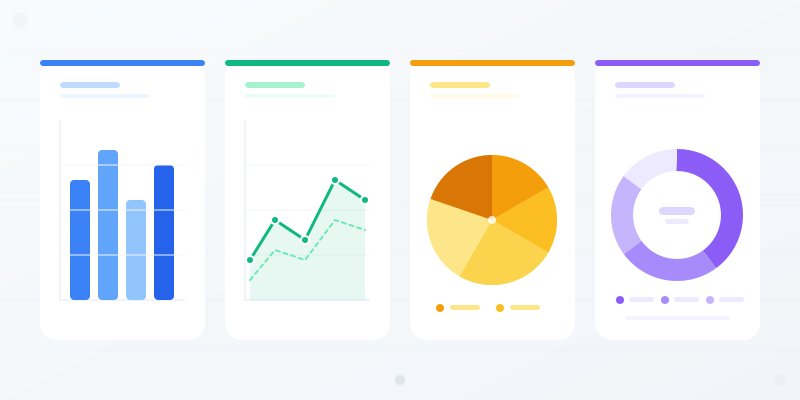
Chart Types Explained: Which Chart Should You Use for Your Data?
Bar vs. line vs. pie — every chart type has a job. Here's when each one works, when it doesn't, and how to pick the right format without overthinking it.
Read more
Data Visualization Best Practices: 6 Rules for Better Charts
Most charts fail because of a handful of avoidable mistakes. Here are the rules that separate clear, effective data viz from confusing noise.
Read moreBuild a Full Infographic
Combine charts, timelines, stat cards, and 80+ widget types into a complete infographic.
Try the Full Editor